Sensorimotor Psychotherapy: Integrating Body and Mind in Healing
Sensorimotor Psychotherapy is a body-centred therapeutic approach that treats trauma, attachment difficulties, and chronic stress by working directly with physical sensation, posture, movement, and nervous system patterns, rather than relying on words and insight alone. Developed by Pat Ogden, PhD, beginning in the 1980s, it integrates principles from neuroscience, attachment theory, mindfulness, and traditional talk therapy to support healing at both psychological and physiological levels. This article is educational and not a substitute for therapy, medical care, or crisis services. If reading this brings up intense distress, flashbacks, dissociation, or urges to harm yourself, please pause and reach out to a qualified mental health professional or crisis resource in your area. What Sensorimotor Psychotherapy is Sensorimotor Psychotherapy was created to address a gap Ogden observed in traditional therapy. Many clients understood their stories intellectually but remained stuck in the same physical and emotional patterns. She noticed that the body communicates implicit meanings and reveals the legacy of trauma and early attachment dynamics in ways that words alone cannot capture. The method welcomes the body as an integral source of information. Rather than using the body only as a way to access psychological issues, Sensorimotor Psychotherapy treats bodily organization, posture, movement, and sensation as central to the healing process. It is designed for trauma and attachment issues, developmental wounds, and related psychological difficulties. Sessions are talk therapy with an explicit somatic component tracked throughout. Theoretical foundations Sensorimotor Psychotherapy draws from several key areas of knowledge. Neuroscience and trauma research Modern trauma research shows that overwhelming experiences can disrupt normal information processing and leave the nervous system stuck in survival states. Sensorimotor Psychotherapy applies this understanding by helping clients notice how trauma shows up in the body, such as chronic tension, numbness, hypervigilance, or collapsed posture. Attachment theory Early relationships with caregivers shape how a person learns to regulate emotions, seek support, and navigate closeness and distance. Sensorimotor Psychotherapy explores how these patterns are held in the body, such as a tendency to brace against contact, avoid eye contact, or hold the breath when feeling vulnerable. Mindfulness and present-moment awareness Mindful awareness allows clients to observe bodily sensations, movements, and impulses without immediate judgment or analysis. This creates space for new information to emerge and for old patterns to be examined with curiosity rather than self-criticism. Cognitive and psychodynamic approaches While Sensorimotor Psychotherapy is body-centered, it does not abandon talk therapy. It integrates cognitive understanding and psychodynamic insight with somatic experience, so that change occurs at multiple levels. Core principles Several principles guide Sensorimotor Psychotherapy practice. The body as a resource The body is not only where trauma is stored. It is also where healing can occur. Sensorimotor Psychotherapy helps clients develop somatic resources, such as grounding through the feet, orienting to the environment, or finding supportive postures that increase a sense of safety and stability. Bottom-up and top-down integration Traditional talk therapy often works top-down, starting with thoughts and narratives. Sensorimotor Psychotherapy adds bottom-up processing, beginning with sensation and movement, then moving toward meaning and story. This dual approach supports more complete integration of experience. Phase-oriented treatment Sensorimotor Psychotherapy follows a phase-based model. The first phase focuses on stabilization and resourcing. The second phase involves processing traumatic material at a pace the nervous system can tolerate. The third phase emphasizes integration, consolidation of gains, and application of new skills in daily life. Completion of incomplete defensive responses Trauma often interrupts natural survival responses such as fight, flight, or freeze. Sensorimotor Psychotherapy helps clients notice and slowly follow impulses that were blocked at the time of the trauma, such as pushing away, running, or protecting oneself, in a way that supports physiological restoration. What happens in a session Sensorimotor Psychotherapy sessions typically blend conversation with careful attention to bodily experience. The therapist helps the client develop precise awareness of physical sensations, posture, movement impulses, breathing patterns, and tension in the body. The client learns to track these experiences in real time with curiosity rather than judgment. When discussing traumatic or triggering material, the therapist pays close attention to the body. They notice shifts in posture, changes in breathing, tension, trembling, or stillness. At key moments, the therapist may gently interrupt the narrative to ask, “Where do you notice that in your body right now?” Together they slow down and stay with the sensation, posture, or impulse that arises. This allows implicit memories and survival responses to surface in a contained way, where they can be explored and reorganized. Key techniques Sensorimotor Psychotherapy uses a range of body-centered interventions. Somatic awareness and tracking Clients are guided to notice and track internal bodily sensations, tensions, movements, and impulses. This facilitates somatic self-awareness and physiological self-regulation. Over time, clients learn to recognize early signs of activation and use this information to make choices about pacing and self-care. Grounding and orientation Grounding involves feeling contact with the floor, chair, or other supports. Orientation means looking around the space to locate safety cues in the environment. These practices help anchor attention in the present and reduce overwhelm. Postural and movement interventions The therapist may invite small postural adjustments to invite openness or stability. Movement may be used to discharge excess activation or to explore incomplete defensive responses. For example, if a client’s body froze during a traumatic event, the therapist might help them notice and slowly follow the impulse to move, push away, or run, at a pace the nervous system can tolerate. Resourcing Resourcing involves identifying and strengthening internal and external supports. This may include noticing moments of calm, recalling supportive relationships, or practicing somatic exercises that increase a sense of capacity and choice. Mindful exploration of core organizers Core organizers are the beliefs, emotions, and survival strategies that shape a person’s experience. In Sensorimotor Psychotherapy, these are explored through the body. A client might notice how a belief such as “I am not safe” shows up as tight shoulders, shallow breathing, or a collapsed chest, and then experiment with new postures or movements that
Hakomi Method: Body-Centered Psychotherapy Techniques
The Hakomi Method is a mindfulness-based, body-centered form of psychotherapy that uses present-moment awareness to explore the beliefs, emotions, and protective patterns that shape a person’s life. Rather than treating the body as separate from the mind, Hakomi works with posture, breath, gestures, tension, movement, and felt sense as meaningful expressions of inner experience. This article is educational and not a substitute for therapy, medical care, or crisis services. If reading this brings up intense distress, flashbacks, dissociation, or urges to harm yourself, please pause and reach out to a qualified mental health professional or crisis resource in your area. What Hakomi is Hakomi was developed by Ron Kurtz in the 1970s. It is an experiential psychotherapy approach that brings together mindfulness, somatic awareness, systems theory, and a compassionate therapeutic relationship. The method is designed to help people explore the unconscious patterns that organize their experience. In Hakomi, these patterns are often called core material. They may include early beliefs such as “I have to manage everything alone,” “My needs are too much,” or “It is not safe to be seen.” Hakomi does not depend on analysis alone. It invites people to notice how these beliefs show up in the body, in the present moment, and in relationship with another person. The five principles Hakomi is guided by five central principles. These principles shape both the therapist’s stance and the practical methods used in sessions. Mindfulness Mindfulness is central to Hakomi. The client is often invited to slow down and notice what is happening inside without immediately trying to change it. This may include noticing a held breath, a clenched jaw, warmth in the chest, an urge to move away, or a sudden feeling of numbness. Mindfulness creates enough distance for experience to be observed with curiosity rather than automatically acted out. Nonviolence Nonviolence means that the therapist does not force insight, push past defenses, or impose a preferred outcome. Protective patterns are treated as intelligent adaptations that developed for important reasons. A Hakomi therapist follows the client’s pace and offers invitations rather than demands. Consent, choice, and respect for limits remain central throughout the process. Mind-body holism Hakomi understands thoughts, emotions, memories, and physical sensations as interconnected. A pattern in the shoulders, a change in voice tone, or a tendency to hold the breath may offer valuable information about a person’s inner world. The body is not treated as proof of a particular story. Instead, it becomes a doorway to direct experience and personal meaning. Unity The principle of unity recognizes that people exist within larger systems. Family, culture, community, spirituality, environment, relationships, and social conditions all influence the way someone experiences themselves and the world. This principle helps therapists avoid reducing a person’s distress to an individual flaw or diagnosis. It keeps the work connected to context and relationship. Organicity Organicity is the belief that people have an innate capacity for healing, growth, and self-organization. Rather than trying to fix or control a client, the therapist creates conditions in which the person’s own wisdom can emerge. In practice, this means listening carefully for what wants to unfold and trusting that meaningful change often develops through small, well-timed experiences. What happens in a Hakomi session Hakomi sessions are usually gentle, collaborative, and paced around the client’s capacity to stay present. A therapist may begin by checking in about what feels most alive or important that day. The therapist then tracks subtle signals such as posture, facial expression, breathing, gestures, shifts in energy, or changes in voice. These signals are not interpreted as fixed truths. Instead, they become possible invitations for mindful exploration. For example, a therapist might notice that a client’s shoulders tighten while speaking about asking for support. The therapist could gently say, “Would you be willing to notice what happens in your shoulders as you say that?” The client may then discover a memory, belief, feeling, or protective impulse that was outside conscious awareness moments earlier. The process does not require clients to tell their whole story in detail. It often works with what is already happening in the here and now. Core Hakomi techniques Hakomi uses a range of body-centered and mindfulness-based techniques. They are offered with consent and adapted to the person’s needs, culture, safety, and readiness. Tracking Tracking involves noticing the client’s moment-to-moment experience. The therapist may observe small changes in breath, posture, facial expression, speech, or movement. For instance, a therapist might notice that a client looks away and becomes quieter when speaking about anger. Rather than assuming what that means, the therapist may invite curiosity about the shift. Mindful access Mindful access is the practice of slowing down enough to explore an experience from within. The person may be asked to close their eyes, notice a sensation, or stay with a particular gesture for a few moments. The goal is not to force memory retrieval. It is to create a safe internal space where unconscious beliefs, emotions, and needs can become more available. Small experiments Hakomi often uses brief, carefully chosen experiments. A therapist may invite a person to try a small movement, repeat a gesture, imagine receiving support, or notice what happens when they hear a simple phrase. For example, a therapist may ask a client to slowly press their feet into the floor and notice what changes. The person might feel more supported, discover discomfort with taking up space, or notice an impulse to pull away. Each response offers useful information. Taking over Taking over is a technique in which the therapist gently supports a tension or incomplete action, with permission. If a person’s arm is held rigidly against their side, the therapist may place a hand nearby or offer verbal support for the impulse to hold back. The intention is not to override the person’s defenses. It is to help them become aware of the effort involved in maintaining the pattern and to explore what it protects. Physicalizing Physicalizing helps make an inner state more visible and tangible.
Group Therapy and Somatic Group Processes
Group therapy and somatic group processes offer a structured, relational space where people can practice regulation, connection, and new ways of being together while working with trauma, stress, and relational patterns. When somatic methods are woven into the group frame, the body becomes part of the shared learning, not just an individual focus. This article is educational and not a substitute for therapy, medical care, or crisis services. If reading this brings up intense distress, flashbacks, dissociation, or urges to harm yourself, please pause and reach out to a qualified mental health professional or crisis resource in your area. What group therapy is and how it works Group therapy is a form of psychological treatment in which a small group of people meets regularly with one or more trained therapists to work on shared or related concerns. The interactions between members are part of the treatment itself. Feedback, modeling, and real-time relational practice help people see how they relate, where they get stuck, and what new options might be possible. Key elements of group therapy include: – Professional facilitation. A licensed therapist leads the sessions, sets boundaries, and uses structured activities, discussions, and interventions to support growth. – Focused goals. Groups may target anxiety, depression, trauma, relational patterns, or skills such as emotion regulation and communication. – Confidentiality and safety. Participants agree to keep what is shared in the group private, which helps create a contained environment for honest work. – Therapeutic techniques. Leaders may use mindfulness, role play, skills practice, and body-based exercises depending on the group’s focus. Groups typically include 4 to 12 members, meet weekly, and run for a set number of sessions or on an ongoing basis. What the research shows about group therapy Research across decades suggests that group therapy can be as effective as individual therapy for many conditions. – A review of 25 years of research found that group and one-on-one therapy were similarly effective across diagnoses. – A major review of group psychotherapy reported that 45 of 48 studies on depression found it effective, and 43 of 46 studies with adequate data found significant symptom reduction. – Group therapy outperformed no treatment in multiple studies, with large effect sizes for depression and meaningful gains for anxiety, even in mixed-diagnosis groups. – A 2024 review of 33 clinical trials found that adults with depression experienced symptom reductions after cognitive behavioral group therapy, and a 2025 study reported that participants in a guided self-reflection group saw a 24% reduction in depression scores and a 19% increase in life satisfaction. Group therapy is especially strong for interpersonal outcomes. One comparative study found that group participants improved more than individual therapy participants on learning to ask for help and rely on others, even when symptom reduction was similar across formats. Why add somatic methods to group work Somatic therapy is a body-centered approach that helps people reconnect with bodily sensations, regulate the nervous system, and process experiences that are not fully accessible through words alone. Trauma and chronic stress often show up as patterns of tension, numbness, collapse, or hypervigilance in the body. In a group setting, somatic work can: – Support regulation. Simple practices such as grounding, orienting to the room, and breath awareness help members stay within a window of tolerance during emotionally charged moments. – Make patterns visible. When several people track sensations at once, shared patterns become easier to notice, such as holding the breath during conflict or tightening the shoulders when speaking up. – Normalize body responses. Hearing others describe similar sensations reduces shame and isolation, which can be especially powerful for people who feel “too much” or “too shut down.” – Build collective resources. The group can practice co-regulation, where steady breathing, gentle movement, or shared grounding exercises help the whole room settle. For a broader introduction to how somatic therapy works and how body-based tools support trauma and stress, see Embodywise’s Somatic Therapy overview. What a somatic group session may look like Somatic group processes vary by facilitator and focus, but many sessions follow a recognizable rhythm. – Opening and grounding. The group begins with a brief check-in and a simple somatic practice, such as feeling the feet on the floor, noticing the contact with the chair, or tracking the breath. This helps members arrive in the room and shift out of autopilot. – Psychoeducation or theme. The facilitator introduces a theme, such as boundaries, shame, or nervous system states, and links it to body cues like tension, temperature, or movement impulses. – Guided somatic exercises. The group practices specific techniques together. These may include gentle movement, stretching, pendulation between activation and calm, or brief body scans to notice where stress is held. – Process and sharing. Members reflect on what they noticed in their bodies and emotions, and how those sensations relate to relational patterns or current life situations. The facilitator helps keep the pace safe and contained. – Integration and closure. The session ends with a grounding practice, a summary of key insights, and suggestions for simple somatic practices between sessions, such as orienting, breath awareness, or short movement breaks. Throughout, the facilitator monitors activation, offers choices, and invites members to stay within their own window of tolerance rather than pushing for intensity. In our Hakomi training groups, we frequently observe that when one member successfully anchors their attention using a grounding practice, the collective nervous system of the room settles noticeably faster. This kind of co-regulation is one of the unique benefits of somatic group work that is harder to replicate in individual sessions. Common somatic techniques used in groups Somatic group processes often draw from a shared toolbox of body-based methods. – Grounding and orienting. Noticing the support of the chair or floor, looking around the room, and naming objects in the environment help anchor attention in the present. – Breath awareness. Observing natural breath or practicing gentle breath patterns can reduce anxiety and support regulation without forcing deep or intense breathing. – Body
Cultural Competence in Therapy: Honoring Diverse Experiences
Cultural competence in therapy refers to a clinician’s ability to understand, respect, and work effectively with people from diverse cultural backgrounds, including differences in race, ethnicity, religion, language, gender, sexuality, disability, and socioeconomic status. It is now considered a core ethical and clinical skill in mental health care, not an optional add-on. This article is educational and not a substitute for therapy, medical care, or crisis services. If reading this brings up intense distress, flashbacks, dissociation, or urges to harm yourself, please pause and reach out to a qualified mental health professional or crisis resource in your area. What cultural competence means in mental health Cultural competence is broadly defined as the ability to communicate and collaborate effectively with individuals from diverse cultural backgrounds, both personally and professionally. In psychotherapy, this means therapists can move between their own cultural lens and the client’s cultural world to understand the meaning of symptoms, relationships, and healing. Major professional bodies, including the American Psychological Association, describe multicultural competency as necessary across all domains of psychology: practice, research, consultation, and education. The APA’s multicultural guidelines emphasize that being responsive to a person means being aware of their cultural background, because it shapes their experience and identity. Cultural competence is often described using a tripartite model that includes: – Cultural attitudes. Sensitivity to one’s own values and biases, and how these affect perceptions of the client, presenting problems, and the therapeutic relationship. – Cultural knowledge. Understanding one’s own cultural background, the client’s cultural background, and how systems and structures operate on those identities and treatment. – Cultural skills. The ability to use therapeutic strategies that are culturally appropriate and sensitive to the client’s context. Cultural humility and its relationship to competence In recent years, many clinicians and researchers have shifted from speaking only about cultural competence to also emphasizing cultural humility. While competence can suggest mastery, humility refers to an ongoing, lifelong process of self-reflection, learning, and power-sharing. Cultural humility involves: – Self-reflexivity and assessment of one’s own biases, privileges, and blind spots. – Appreciation of the client’s expertise on the social and cultural context of their own life. – Openness to establishing power-balanced relationships with clients. – A lifelong dedication to learning rather than assuming one has “arrived” at competence. Most contemporary frameworks now recommend that providers cultivate both cultural competence and cultural humility. Competence provides a foundation of knowledge and skills, while humility keeps the work relational, curious, and responsive to each unique person. Why cultural competence matters for outcomes Research and clinical guidelines increasingly link cultural competence to better mental health outcomes. – Meta-analyses confirm that culturally adapted treatments are effective and often superior to control conditions. In several reviews, adapted versions of evidence-based therapies had better outcomes than standard versions for clients from diverse backgrounds. – Systematic reviews of cultural competence trainings for mental health providers show that such trainings generally improve knowledge, attitudes, and skills. – Studies in broader health care settings indicate that culturally competent care reduces health disparities, lowers perceived racism, improves patients’ perception of care, and increases adherence to treatment. In trauma therapy specifically, findings suggest that culturally competent practices improve therapeutic relationships and effectiveness in the process. Clients are more likely to feel understood, safe, and willing to engage when their cultural context is acknowledged and respected. Core components of culturally competent therapy Culturally competent therapy is not a single technique but a set of interrelated practices. – Self-awareness and ongoing reflection. Therapists regularly examine their own cultural identities, assumptions, and biases, and how these show up in the room. – Knowledge of diverse worldviews. Clinicians learn about different cultural beliefs about mental health, healing, family, spirituality, and help-seeking, while recognizing variation within any group. – Attention to power and systems. Culturally competent practice includes awareness of how racism, discrimination, immigration status, poverty, and other structural factors affect mental health and access to care. – Flexible assessment and formulation. Therapists adapt how they ask about symptoms, trauma, and strengths to fit the client’s cultural language and explanatory models. – Culturally adapted interventions. Evidence-based therapies are modified to align with cultural values, communication styles, and community resources, rather than applied in a one-size-fits-all way. – Collaboration and humility. Therapists invite clients to teach them about their cultural context, check assumptions, and co-create goals and methods. How cultural competence shows up in session In practice, cultural competence is visible in the details of how therapy unfolds. – Language and communication. Therapists pay attention to preferred language, use of interpreters when needed, and sensitivity to indirect communication styles, honorifics, or norms around eye contact and emotional expression. – Explanatory models of distress. Instead of imposing a single diagnostic framework, clinicians explore how the client and their community understand suffering, such as spiritual, relational, or somatic explanations. – Family and community involvement. For many clients, healing is a collective process. Culturally competent therapists may invite family or community members into sessions when appropriate and desired by the client. – Rituals and practices. Therapists remain open to integrating culturally meaningful rituals, prayers, storytelling, or body-based practices into the therapeutic process when they support healing. – Attention to microaggressions. Clinicians monitor for subtle invalidations related to culture, identity, or background, and are willing to name and repair ruptures when they occur. In our somatic and Hakomi-informed work, we often notice that when a therapist explicitly acknowledges a client’s cultural background and invites them to describe what safety and support feel like in their own cultural terms, the client’s nervous system settles more quickly. This small act of cultural validation can make body-based interventions feel more accessible and less foreign. Cultural competence in trauma and somatic work Trauma and somatic therapies carry their own cultural assumptions about the body, emotions, and healing. A culturally competent approach to trauma work includes: – Recognizing that different cultures have different languages for trauma, dissociation, and resilience. – Understanding how historical, intergenerational, and collective trauma shape present-day symptoms and relational patterns. – Adapting somatic interventions so
Intergenerational Trauma: Healing Family Wounds
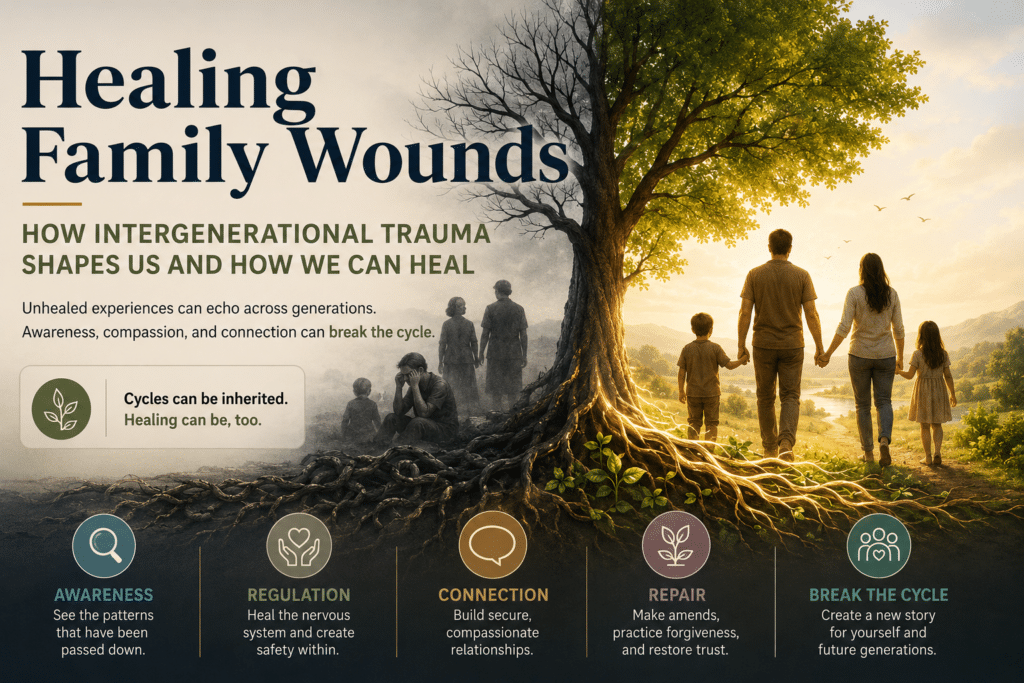
Intergenerational trauma describes how unhealed experiences in one generation reverberate in the bodies, emotions, and relationships of the next, often without the later generation directly living through the original events. Healing family wounds means helping those patterns become seen, felt, and worked with, rather than silently repeated. This article is educational and not a substitute for therapy, medical care, or crisis services. If reading this brings up intense distress, flashbacks, dissociation, or urges to harm yourself, please pause and reach out to a qualified mental health professional or crisis resource in your area. What intergenerational trauma is Clinical and research writing uses intergenerational trauma (also called transgenerational or generational trauma) to describe the way trauma symptoms and stress patterns in one generation influence descendants. This influence can show up as heightened stress responses and over-active nervous systems, increased risk of mental health symptoms, and relational difficulties such as fear of closeness, chronic conflict, or emotional numbing. Importantly, later generations may experience the effects of trauma without directly experiencing the original events. They inherit stories, behaviors, attachment patterns, and physiological stress responses shaped by what came before. How family trauma gets transmitted Research points to several overlapping pathways for how trauma travels across generations: Attachment and caregiving. When parents carry unresolved trauma or high adverse childhood experiences (ACE) scores, studies show they are more likely to struggle with emotional availability or harsh and inconsistent parenting. This can shape children’s attachment styles and expectations of relationship. Stress physiology and epigenetics. Work in developmental origins of health and disease and trauma suggests that chronic stress in one generation can influence stress hormone regulation and other physiological processes in descendants. Family narratives and roles. Families pass down messages such as Never let your guard down or loyalties to silence and self-sacrifice, often rooted in past survival strategies. Social and historical context. Collective traumas war, displacement, systemic oppression can impact communities across generations through ongoing structural stress and shared narratives of threat. None of these pathways make repetition inevitable. They explain why patterns can feel strong and why support and structure are often needed to change them. Noticing intergenerational patterns in everyday life Intergenerational trauma often shows up as familiar, disproportionate reactions. A small disagreement may trigger rage or shutdown that feels bigger than the moment. Certain topics money, illness, conflict, vulnerability may feel taboo, as if speaking about them breaks an unwritten rule. Family members may repeat roles caretaker, scapegoat, invisible one across generations. Studies on parental ACEs and offspring outcomes note that parents with higher ACE scores are more likely to report difficulties with regulating emotion and consistent caregiving. In daily life, this might look like oscillating between over-involvement and withdrawal, being present for practical care but distant for emotional needs, or feeling intense guilt or fear when children express distress, without understanding why. Recognizing these as patterns with history rather than personal defects can be a first step toward change. Foundations of healing family wounds Healing intergenerational trauma is usually gradual and multi-layered. Research and clinical guidance highlight several common foundations: Making patterns visible, not secret. Breaking cycles starts with naming what happened and how it appears now. This can involve mapping family experiences and roles, for example with a genogram or survival genogram, and identifying repeated themes silence, criticism, avoidance, over-responsibility. Supporting current caregivers and adults. Reviews on parental ACEs show that improving parents’ emotional regulation, support networks, and access to trauma-informed care can reduce risk for children. This means healing is not only about children; it is very much about resourcing the adults currently carrying the load. Trauma-informed, relationship-focused therapy. Clinical work on attachment trauma stresses that people whose trauma occurred in relationships often need secure, attuned relationships to heal. Therapy that focuses on safety, pacing, consent, and repair can create experiences that contrast with earlier environments. Attention to structural and collective context. When trauma is linked to systemic oppression or historical events, individual work is helped by acknowledging those realities and, where possible, connecting to community and collective healing practices. Somatic and body-centered perspectives Somatic trauma approaches highlight that trauma is held as patterns of activation, collapse, and muscle tension, not only as stories. In families, these patterns can look like chronic hypervigilance, a tendency to freeze or dissociate during conflict, and learned bodily habits tight shoulders, shallow breath, guarded posture that children copy without being taught. Somatic work supports intergenerational healing by tracking sensations and impulses, noticing tightness, numbness, or urges to flee in parenting or family moments and experimenting with small adjustments in breath, posture, and movement. It includes orienting to present-time safety so the nervous system can register that the current environment is different from past danger, and allowing small, conscious movements that express previously inhibited fight or flight impulses in a safe context. When adults in a family learn to include their bodies in healing, they often find it easier to stay with strong feelings both their own and their children’s without repeating old reactions. Practical directions for families These directions are general and are best adapted with professional support: Gentle curiosity about bigger than the moment reactions. When anger, fear, or collapse feels disproportionate, asking What might this be echoing? can open space between present and past. Creating small, consistent safety rituals. Predictable routines, moments of shared regulation, such as breathing together or short check-ins, and clear, kind boundaries provide new experiences for nervous systems shaped by chaos. Inviting story without forcing disclosure. Allowing elders or parents to share their experiences at a pace that feels safe, while making it clear that silence about harm is not required. Seeking trauma-informed support. Trauma-informed therapy, parenting programs, and support groups can reduce intergenerational risk by strengthening skills and relationships. Intergenerational healing in a somatic and Hakomi-informed frame Mindful, body-centered approaches such as Hakomi Mindful Somatic Psychotherapy and other somatic frameworks used in trauma training treat intergenerational patterns as living in the present-moment body and relational field. In this frame, the therapeutic relationship is used as
Parenting From a Healed Place: Breaking Generational Cycles

Many parents find themselves saying, I am doing everything I can not to repeat what I went through, and still notice familiar patterns surfacing in moments of stress. A sharp tone comes out that sounds like an old voice. A wave of collapse or rage feels bigger than the situation with the child in front of you. Parenting from a healed place is not about being perfect. It is about slowly shifting from reactive, inherited patterns toward more conscious, regulated responses, so that your children inherit a different emotional climate than the one you grew up in. In the language of trauma, generational or intergenerational trauma refers to the way unresolved experiences in one generation can shape the nervous systems, expectations, and relationships of the next. Research on adverse childhood experiences (ACEs) has shown that parents with higher ACE scores are more likely to struggle with emotional availability and may be more likely to use harsh or inconsistent parenting, which in turn increases risk for their children. Breaking cycles is possible, but it usually requires support, skills, and new ways of understanding what is happening. This article is educational and not a substitute for therapy or medical care. If reading this brings up intense distress, flashbacks, dissociation, or urges to harm yourself, please pause and reach out to a qualified mental health professional or crisis resource. Understanding generational patterns Generational patterns can show up as repeated themes rather than exact copies of what happened before. One family may pass down rigid silence around conflict. Another may hand on chronic criticism. Another may transmit a sense that feelings are too much or that needs are burdens. Studies on intergenerational trauma and adverse childhood experiences suggest that when parents carry unresolved trauma, they may have more difficulty regulating emotion, staying present during children’s distress, and offering consistent warmth. This does not mean parents are doomed to repeat harm. It does mean that awareness and support are central ingredients in doing something different. From a nervous system perspective, the body learns early on how to respond to threat, rejection, or emotional chaos. Those responses can become automatic. When a child cries, a parent’s body may respond to the echo of a previous generation’s story: You are too much. Stop it. Or Nobody was there for me; I have to shut down to survive. Parenting from a healed place involves beginning to notice these echoes and understand them as history, not as destiny. What it means to parent from a healed place Parenting from a healed place does not mean you have resolved everything before you have children. It means you are willing to stay in contact with your own process while you care for someone else. Several elements tend to matter: Awareness of your own story. Breaking generational cycles begins with understanding the contexts in which your nervous system and relational expectations were shaped. This might include recognizing your own ACEs, naming family patterns of silence or volatility, and acknowledging both the pain and the strengths you carry. Commitment to regulation and repair. No parent is regulated all the time. Parenting from a healed place means valuing regulation and repair as core practices. It involves noticing when you are outside your window of tolerance, pausing, and returning to your child with more steadiness rather than expecting yourself never to react. Willingness to seek support. Systematic reviews and clinical guidelines emphasize that breaking intergenerational cycles often requires external support, such as trauma-informed therapy, parenting groups, or community resources. Support is not a sign of failure. It is one of the ways you change what is available to the next generation. Attention to the child’s experience, not only your intention. Many parents intend to be different, but impact matters more than intention. Parenting from a healed place includes checking in on how your child is experiencing you and being willing to adjust based on what helps them feel safer and more understood. Key practices for breaking cycles Below are several practices that many trauma-sensitive parenting models and intergenerational trauma studies highlight. They are not rigid steps but ongoing directions. 1. Slowing the moment One of the simplest, and hardest, shifts is inserting even a brief pause between your child’s behavior and your response. That pause might be one conscious breath or a few seconds of feeling your feet on the floor before you speak. In those few seconds, you might ask quietly: What is happening in my body? What story is this touching? Am I reacting to my child or to something older? This kind of micro-reflection can help you respond from the present rather than from an unmanaged past. 2. Regulating your own nervous system Many parents with trauma histories move quickly into fight, flight, freeze, or dissociation when children are noisy, angry, or distressed. Somatic and body-based approaches to trauma emphasize helping adults learn to recognize their own states and to use simple regulation tools: slower breathing, feeling weight on the ground, orienting visually around the room, or using supportive touch. These actions may sound small, but they are what allow the adult nervous system to remain more present and less overwhelmed, which reduces the likelihood of harsh or shutting-down responses. 3. Naming and owning patterns Parenting from a healed place involves being able to say, to yourself and sometimes out loud: A part of me learned to yell when I am scared. Or A part of me learned to disappear when someone is upset. This language helps you see your reactions as patterns that developed for reasons rather than fixed truths about you. From there, you can take responsibility without drowning in shame. You might say to a child, I got louder than I meant to; that was my old pattern showing up. I am working on doing that differently. This kind of ownership can be a powerful corrective experience for children who otherwise might blame themselves. 4. Choosing different small actions Cycle-breaking rarely happens through one big decision. It happens
Attachment Theory and Healing Insecure Attachment Patterns
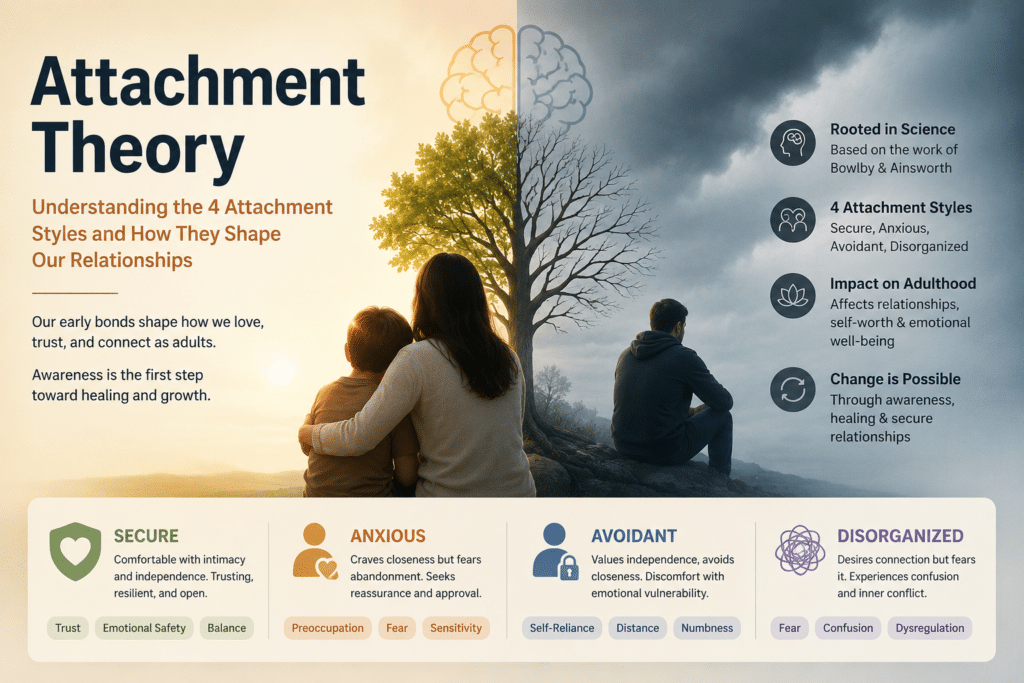
Imagine a child who reaches for a caregiver when frightened and, more often than not, finds warmth and steadiness waiting for them. Over time, that repeated experience turns into an internal expectation: I am held. Help is available. I can come back to myself after being upset. This expectation becomes part of how the nervous system navigates closeness, conflict, and the risk of needing someone. Attachment theory suggests that when early caregiving is generally sensitive and responsive, children tend to form secure attachment, a felt sense that relationships can be a reliable source of comfort and support. When caregiving is inconsistent, unavailable, frightening, or chaotic, the system adapts in other ways, creating what we call insecure attachment patterns. These patterns are not moral failings. They are learned strategies for staying as safe as possible in the environments the child had. This article is educational and not a substitute for therapy or medical care. If reading this brings up intense distress, flashbacks, dissociation, or urges to harm yourself, please pause and reach out to a qualified mental health professional or crisis resource. Where attachment theory comes from Attachment theory was first articulated by psychiatrist and psychoanalyst John Bowlby, who studied children separated from their primary caregivers and argued that attachment is an innate, biologically based behavioral system. Bowlby proposed that infants seek proximity to caregivers when threatened and use them as a secure base from which to explore. Psychologist Mary Ainsworth expanded Bowlby’s work by observing infants and caregivers in the Strange Situation, a structured procedure involving brief separations and reunions. From this, she identified distinct attachment patterns in infancy: secure, insecure-avoidant, and insecure-ambivalent or resistant. Later, researchers described disorganized attachment, a pattern in which the attachment system itself appears confused or dysregulated, often in contexts where the caregiver is both a source of comfort and a source of fear. Attachment research has since moved into adulthood, showing that early attachment experiences are associated with characteristic ways of relating in adult relationships, including patterns known as secure, anxious or preoccupied, avoidant or dismissing, and disorganized or fearful. Importantly, studies on earned secure attachment show that attachment can change across the lifespan, especially in the presence of supportive, coherent relationships and effective therapy. The core attachment patterns Secure attachment Secure attachment develops when caregivers are mostly responsive, emotionally available, and able to repair misattunements. Children in these contexts generally learn that their needs can be seen and responded to, that others are usually safe to turn to, and that exploration and connection can coexist. As adults, people with more secure attachment often find it easier to trust, to tolerate disagreement without feeling everything is at risk, and to balance independence with closeness. They may still experience pain and conflict, but they rely on both self-regulation and co-regulation without feeling that every rupture means the relationship is over. Anxious attachment Anxious or ambivalent attachment tends to arise when caregiving is inconsistent: sometimes engaged and nurturing, sometimes distracted, withdrawn, or overwhelmed. The child cannot reliably predict when comfort will be available, and the attachment system becomes highly activated, scanning for signs of threat or loss. As adults, anxious attachment often appears as preoccupation with whether others will stay, fear of rejection or abandonment, and strong pulls toward reassurance and closeness even when that intensity contributes to conflict. The body may hold this pattern as racing thoughts, tight chest, and an urge to move toward others quickly. Avoidant attachment Avoidant attachment typically develops when caregivers are emotionally distant, dismissive of need, or convey that dependence is unwelcome. The child learns that expressing distress does not lead to comfort and may bring shaming or rejection, so the system inhibits attachment signals. In adult relationships, avoidant patterns may look like emphasizing self-sufficiency and downplaying need, discomfort with vulnerability, and withdrawing or shutting down when closeness feels too intense. Somatically, people often describe numbness, tightness, or a sense of being cut off from deeper feeling. Disorganized attachment Disorganized attachment emerges when caregiving is frightening, severely inconsistent, or involves unresolved trauma in the caregiver. The child faces a conflict: the person they need for safety is also a source of fear. The attachment system cannot organize a coherent strategy, and behavior may appear contradictory or disoriented. In adulthood, disorganized or fearful patterns often involve strong desire for intimacy combined with fear of it, sudden shifts between approach and withdrawal, and dissociation or shutdown during relational stress. These patterns are associated with higher levels of distress and often benefit from especially careful, trauma-informed work. How attachment patterns live in the body Attachment is not only a psychological lens; it is also a nervous system pattern. The body remembers how it had to organize around connection, separation, and threat. For example, someone with anxious attachment might feel racing thoughts, tight chest, and a surge of panic when a partner becomes less responsive, even if no rupture has actually occurred. Someone with avoidant attachment might feel a subtle numbness or tension when a conversation turns toward vulnerability, noticing an urge to withdraw or change the subject. Research suggests that insecure attachment styles are associated with differences in emotional processing, stress response, and somatic symptoms. This is part of why insight alone often does not fully shift attachment patterns: the body needs new experiences, not just new ideas. Somatic therapy and other body-centered approaches explicitly include the nervous system and sensations in attachment work. Practitioners track changes in breath, posture, muscle tone, and felt sense as attachment themes arise, helping clients notice and gently experiment with new responses in real time. What healing insecure attachment involves Healing insecure attachment is less about becoming secure in a perfect way and more about building capacity: capacity to notice, to regulate, to seek support, and to stay present in relationship. Key elements include: Relational safety and consistency. Studies on earned secure attachment emphasize the importance of relationships that are emotionally available, coherent, and able to support new ways of relating. In therapy, this often means
Couples Therapy: Healing Relationships Through Somatic Work
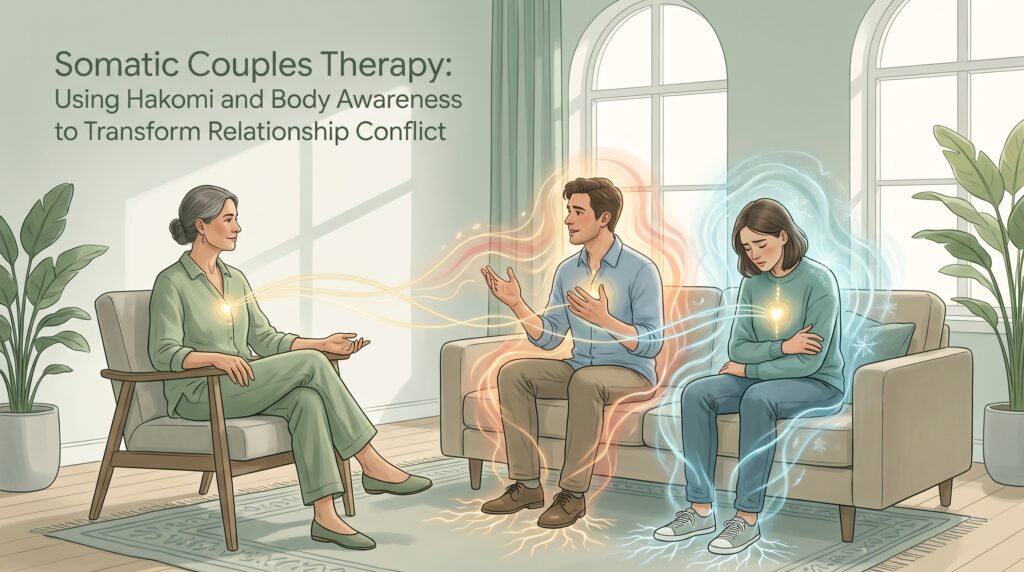
Two people sit on the couch. One partner is leaning forward, voice sharp, words coming fast. The other has gone quiet, eyes lowered, shoulders pulled back as if bracing for impact. The content of the conflict may sound familiar: money, sex, parenting, trust. But the deeper story is unfolding in breath, gaze, muscle tension, pacing, and distance. Many therapists have been in this moment, sensing that the body is speaking as loudly as the words, yet not always knowing how to work with it skillfully. This article is educational and not a substitute for therapy or medical care. In couples work, moments like this are often a turning point. If we stay only with the narrative, the session can circle around familiar positions. If we begin to track the nervous systems in the room, something different becomes possible. Hakomi and other somatic approaches offer a way to slow the pattern down enough that both partners can begin to notice what is happening inside and between them, right now, in the living field of the relationship.[1] The room is full of nervous systems Couples therapy can be intense because we are not working with one regulated or dysregulated person at a time. We are sitting with two nervous systems affecting each other moment by moment. A glance, a sigh, a slight turn away, these can all register as threat, longing, protest, or collapse in an instant. This is one reason that talk alone often reaches its limit. A couple may understand their cycle intellectually and still be unable to interrupt it in real time. The Hakomi Institute describes mindfulness in couples therapy as a way to help partners move from adversarial interactions to more vulnerable, collaborative contact, while therapists track subtle messages and use present-moment experience to shift entrenched patterns.[1] Psychobiological approaches to couples therapy make a similar point. PACT, for example, is organized around the idea that partners need to understand and respond to each other’s nervous systems, not only each other’s words. In this frame, co-regulation is not a side note. It is central to how safety, repair, and secure functioning are built in a relationship.[2][3] What the body adds to the couple’s work Somatic couples therapy focuses on what is happening in the present moment: in the body, in contact, and in the therapeutic relationship. It asks questions like: “What happens in your chest when your partner looks away?” “What do you notice in your jaw right before you interrupt?” “Can you feel your feet while you say that difficult thing?” This matters because conflict is often not driven by content alone. It is driven by the state. When one partner goes into a fight, another may move toward freeze or flight. Someone who appears avoidant may actually be overwhelmed. Someone who seems demanding may be desperately trying to maintain a connection. The body helps us see the pattern underneath the strategy or story.[3][1] Hakomi is particularly useful here because it is mindfulness-centered and experiential. The method emphasizes body awareness, compassionate presence, and the exploration of unconscious patterns through present-moment experience. That orientation can support couples in noticing not only what they believe about each other, but also how those beliefs live in posture, breath, voice, and action tendencies.[1] If you feel called to bring this depth of somatic awareness into your couple’s work, somatic trauma therapy training (ISITTA) and Hakomi-informed somatic coaching certification path offer pathways for building the clinical presence, tracking skills, and trauma-informed grounding this work asks of us. Attachment lives in posture and pace Attachment dynamics are not just cognitive templates in the mind. They are embodied patterns. In the therapy room, anxious attachment may show up as leaning in, speaking quickly, scanning the partner’s face for signs of rupture, or feeling panic in the belly when contact feels uncertain. Avoidant adaptations may look like a flattened tone, a tightened chest, a slight turn away, delayed responses, or an impulse to move away from emotional intensity by becoming abstract or overly reasonable. Disorganized patterns can feel even more confusing because they often carry simultaneous impulses: reach and recoil, longing and fear, activation and collapse. One partner may want closeness and then tense the body the moment it arrives. Another may protest disconnection and then lose the capacity to stay present once the other person truly turns toward them. A somatic lens helps the therapist track these patterns without pathologizing them as character flaws. We begin to see intelligent survival responses rather than bad behavior. The central question shifts from “What is wrong with this person?” to “What happens in this person’s system when connection feels uncertain, too much, or not enough?” That shift alone can soften blame and open curiosity. A small pause can change everything Consider a composite couple like this: one partner says, “You never really show up for me.” The other crosses their arms, looks toward the floor, and says, “Nothing I do is ever enough.” Within seconds, the first partner gets louder, the second goes more distant, and both are certain they are being abandoned. In a talk-only frame, we might spend much of the hour analyzing the argument. In a somatic frame, the work is to slow the sequence down. I might ask the accusing partner to pause and notice what is happening in the body right before the words get louder. Perhaps there is heat in the face, tightness in the throat, and a young terror of not mattering. I might ask the withdrawn partner to notice what happens right before the eyes drop. Perhaps there is pressure in the chest and a familiar collapse that says, “I will fail here, so I should disappear.” Once those states are named and tracked, the interaction is no longer only content. It becomes workable. One partner may place a hand on the heart and feel the urgency without escalating. The other may orient to the room, feel their feet, lift their gaze for three seconds longer than usual, and
When Your Yes and Your Body Disagree: A Somatic Approach to Boundaries in Relationships

Many of us have had the experience of saying yes while something quieter inside us was saying no. The face smiles, but the chest tightens. The voice agrees, but the breath goes shallow and the stomach feels off. Sometimes you follow through, staying on the call, taking on the project, agreeing to the visit, even as your body has already started shutting down or drifting away. That gap between the word and the felt response is at the center of most boundary difficulty. Many people try to address it from the top down, using scripts, affirmations, or rules about what they should and should not allow. But when the nervous system is still organized around old survival strategies like fawning, freezing, or over-adapting, those cognitive tools often cannot hold. The body keeps running the older program. This piece explores what it can look like to approach boundaries differently, as something lived and felt rather than performed, starting with what the body already knows. This article is educational and not a substitute for therapy or medical care. If reading this brings up intense distress, flashbacks, dissociation, or urges to harm yourself, pause and reach out to a qualified mental health professional or crisis resource. This kind of somatic work can be powerful, and it tends to go safest when it has appropriate support alongside it. When yes and no split inside you You say yes to helping a friend move. The moment the word leaves your mouth, your shoulders tighten and a low pressure starts building behind your eyes. Or you sit through a long meeting, smiling while your attention wanders and your limbs begin to feel slightly numb. Physically present. Already gone inside. This is what it looks like when your verbal yes and your body’s no are running at the same time. If you grew up in an environment where being helpful, likable, or non-disruptive mattered more than your own signals, that kind of split can become so habitual it goes unnoticed. The aim of somatic boundary work is not to blame that pattern or force it to change quickly. It is to recognize it as an intelligent adaptation, and then, gradually, to build more choices. What boundaries actually are Boundaries are the ongoing ways you protect and care for your time, energy, body, and emotional life while staying in connection with others. They are not a fixed personality trait or a rule you install once and maintain through willpower. They are living, context-sensitive decisions about how much closeness, intensity, or demand feels workable right now. Boundaries can show up across many dimensions: Healthy limits are not walls that keep people out. They are structures that make connection clearer and more sustainable. When you know what you can genuinely offer, and others can trust what you say, relationships tend to feel more honest and less draining over time. How the nervous system shapes what you can say Many boundary struggles are not character flaws. They are expressions of how the autonomic nervous system learned to keep you safe. Polyvagal Theory, developed by Stephen Porges, describes how the nervous system continuously shifts between states of social engagement, mobilization, and shutdown in response to cues of safety or danger, often well below the level of conscious thought.[1][2] The survival responses that shape boundary behavior include: When early relationships taught you that having needs was dangerous, or that saying no brought shame, withdrawal, or punishment, your system may have learned that over-adapting is the safest option. These strategies often begin in childhood and carry forward into adult relationships, workplaces, and even therapeutic spaces.[3][4] When you feel genuinely safe and regulated, what Polyvagal Theory calls the ventral vagal state, you can connect socially, make choices more flexibly, and feel a sense of being present to both yourself and others.[1] When that felt safety drops, the system defaults to defense, and the capacity to sense and communicate a clear yes or no becomes much harder to access. What the body says before words form Very often the body registers a boundary issue before the mind can articulate it. You might notice: These sensations are not exaggeration. They are signals. Your body is tracking how much contact, intensity, or intimacy feels workable in this moment, and it has an answer before the thinking mind catches up.[5] If you can begin to read those physiological cues as information rather than inconvenience, you open access to a real-time resource. One way to reframe this internally: my body is giving me data about my current capacity. You do not have to act on every sensation immediately. But noticing it matters. Somatic first steps toward clearer limits For people who tend to freeze, fawn, or over-adapt, moving straight into direct confrontation is often too much too fast. Somatic boundary practice starts with smaller experiments, building a felt sense of yes and no before any words are required.[4][5] One breath, three sensations Before responding to a request, pause and take one slow breath. Notice three sensations: the weight of your body in the chair, the temperature of your hands, the quality of your breath. Then sense whether your body orients toward the request or away from it. You can still choose your answer. Now your body is part of that conversation. Soft delay phrases with grounded feet Practice saying “I need to think about it,” “I’m not sure if I can,” or “Let me check what I have available,” while actively feeling your feet on the floor and your lungs moving. Try this alone first, or with someone safe. The goal is learning that you can stay in your body and still pause the automatic yes. The exact wording matters less than the grounded pause itself. Sensing your comfortable distance Seated or standing, slowly extend your hands in front of you as though feeling the edge of an invisible bubble. Notice where “comfortable” seems to begin. Then imagine people you know at various distances inside that space. Where does
How Internal Family Systems Therapy And Somatic Parts Work Help With Everyday Trauma Healing

Most people know the feeling of being pulled in opposite directions by different sides of themselves. One part of you wants to slow down and rest, another insists you keep working so you do not fall behind, and a third quietly criticizes how you are handling it all. Internal Family Systems (IFS) therapy offers a respectful way to understand these inner dynamics and to relate to them with more compassion and choice, especially when we include the body and nervous system in the process. IFS sees your inner world as a system of parts, all guided by an innate core presence called Self. Somatic parts work adds the body as a doorway into these parts, which can be especially helpful for trauma healing. Everyday Inner Conflict In Ordinary Life Think about a few common situations. You get invited to a gathering after a long week. One side lights up, craving connection. Another sighs with relief at the idea of staying home in silence. A wary voice warns that you will feel awkward or out of place. These reactions are not random. They are different parts of you trying to protect what matters. Or imagine sitting down to work on a creative project. A driven, focused part wants to push forward. A younger, anxious part worries about judgment and begins to stall, while an inner critic comments on every perceived mistake. You might feel tension in your jaw, fluttering in your stomach, or a heavy weight in your chest as these parts compete for control. In IFS language, these are all inner parts. They each hold their own beliefs, fears, and hopes, and they each show up in your body in distinct ways. The aim is not to get rid of any of them. The aim is to build a trusting relationship with each one so they no longer have to work so hard. Self And Parts In The IFS Model IFS starts from a straightforward idea. Our inner world is made up of many parts, and every person also has an innate core presence called Self. Self is not another part. It is the calm, curious, compassionate awareness that can turn toward each part and listen. A few key points: Self often shows up as a sense of spaciousness in your chest, steadier breath, softer eyes, and a grounded feeling in the body. From this place, you can be with a scared or reactive part instead of being completely blended with it. Types Of Parts In IFS IFS describes three broad categories of parts. Exiles carry emotional wounds. Managers and firefighters are both protectors that work very hard to keep those wounds from overwhelming you. Exiles As Hurt Younger Parts Exiles hold painful experiences and beliefs that were too much to feel at the time. They often carry shame, fear, grief, loneliness, or the conviction that they are unlovable or too much. An exile might be a six year old feeling left out at school, or a teenager who felt deeply rejected at home. In adult life, exiles can be stirred by seemingly small events. A friend canceling plans might activate an exile that feels abandoned. A correction at work might wake up a part that is sure it is a failure. When exiles get triggered, big waves of emotion can flood the system, along with intense sensations like a clenched throat, a collapsing chest, or a hollow feeling in the belly. Managers As Parts That Stay In Control Managers are proactive protectors. Their job is to prevent anything that might stir up exiles. They often organize life, plan ahead, and keep you functioning. On the surface they can look responsible and successful. Underneath, they may be driven by fear that if they let up, old pain will come roaring back. A manager might show up as: Managers often live in tight shoulders, a forward leaning posture, or a constantly busy mind that struggles to rest. Firefighters As Parts That Put Out Emotional Fires Firefighters can be seen as reactive protectors. They don’t stop the next injury from happening, rather they come to the rescue when already suffering exiles are stirred up, shutting down or distracting the deeply felt emotion ASAP. For instance: Scrolling, drinking, eating, and working compulsively after a painful communicationShutting down, anger or withdrawal abruptly if you feel criticised.Desires to escape through fantasy, sex, or risky behaviour. Firefighters often manifest in the body as restless legs, sudden heat, a spike of adrenaline, or a fog that blots everything out. According to the IFS therapy, managers and firefighters aren’t evil. They are trying to prevent exiles from being overwhelmed with pain. Gradually, with the help of Self, these protectors can ease into less drastic roles if exiles do not carry such heavy burdens anymore. How Parts Show Up In The Body And Nervous System IFS was first described in psychological language, yet many practitioners and clients notice that parts are just as vivid in the body as they are in thoughts or emotions. Somatic IFS and related approaches take this seriously. Parts often appear through: From a nervous system view, protectors often correspond with fight, flight, or fawn responses, while exiles may carry freeze, collapse, or overwhelmed states. When we slow down and feel these patterns in the body, parts become easier to recognize and to befriend. What An IFS Informed Session May Feel Like If you are new to this, you might wonder what actually happens in an IFS oriented session, especially one that includes somatic awareness. Experiences vary, yet some common elements show up across many practitioners. A session may include: Somatic IFS often weaves in simple body based practices, like tracking small movements, experimenting with posture, or using breath to help the system stay within a workable range of activation. The focus is not on performing IFS correctly. The focus is on creating a relationship between Self and your parts that feels safer and more stable over time. Why IFS And Somatic Therapy Fit