Working With Dissociation: Assessment and Treatment Approaches
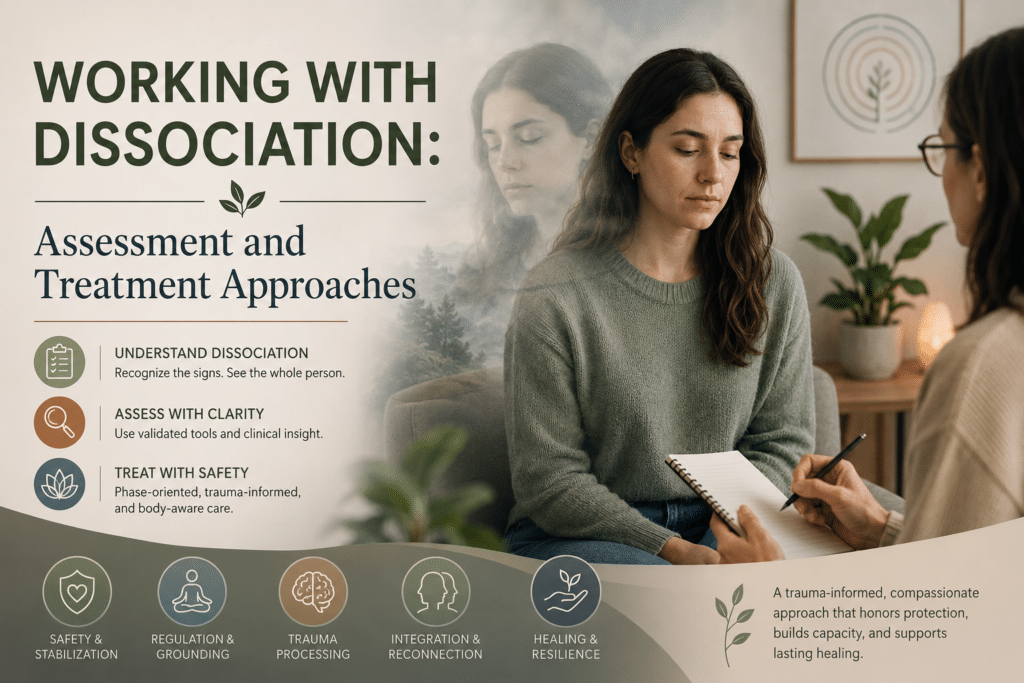
You are mid-session and something shifts. The client was describing an argument with their mother, and now their voice has gone flat. Their eyes are fixed somewhere past your shoulder. When you ask what they are noticing, there is a long pause, and then a quiet answer: “I don’t know. I wasn’t really here for a second.” Most therapists have met this moment. Some recognize it immediately. Others only realize later that a client has been drifting in and out of contact for months, and that the treatment has been talking to a part of the person while another part waits somewhere out of reach. Dissociation is common, it is often subtle, and it changes what good therapy needs to look like.[1][2] This article is educational and not a substitute for therapy, medical care, or crisis services. If reading this brings up intense distress, numbness, a sense of unreality, or urges to harm yourself, please pause and reach out to a qualified mental health professional or crisis resource in your area. What dissociation is, and why it exists Dissociation is a disruption in the normal integration of consciousness, memory, identity, emotion, perception, and behavior. That is the clinical definition. In the room, it looks like a person becoming disconnected from their body, their feelings, their surroundings, or their sense of who they are.[2][3] It exists on a continuum. Almost everyone dissociates mildly: highway driving on autopilot, losing an hour in a book, walking out of a stressful meeting with no memory of the hallway. At the other end sit the dissociative disorders, where disconnection is frequent, involuntary, and disruptive enough to interfere with relationships, work, and safety.[3][2] The most important frame for clinicians is that dissociation is protective. It usually develops as a survival response to experiences that were overwhelming and inescapable, most often chronic childhood trauma, neglect, or abuse. When a child cannot fight or flee, the nervous system finds another exit: it leaves internally. What was adaptive then becomes automatic later, firing in situations that are stressful but no longer dangerous.[1][2][4] Recognizing dissociation in the room Assessment begins with tracking, not with a questionnaire. Dissociation announces itself in small ways. A client’s gaze goes distant or glassy. The voice flattens or shifts register. They lose the thread mid-sentence and cannot find it again. They report watching themselves from outside, or say the room looks foggy or far away. Some clients describe gaps: they cannot account for how they got somewhere, or a whole conversation is simply missing.[2][3] Many clients will not volunteer these experiences. Some assume everyone lives this way. Others fear sounding crazy. This is why direct, normalizing questions matter. Asking “Do you ever lose time?” or “Do you ever feel like you’re watching yourself from outside your body?” often opens material that years of open-ended talk never touched.[1][2] It also helps to know what dissociation can hide behind. It is frequently mistaken for inattention, resistance, low motivation, or a mood disorder. A client who “spaces out” may be labeled ADHD. A client who goes numb during exposure work may be described as not engaging. Screening for dissociation before beginning any trauma-focused treatment protects both of you from working on material the client is not actually present for.[1][5] Structured assessment tools Clinical observation can be supported with validated instruments. The Dissociative Experiences Scale (DES-II) is a widely used self-report screen that gives a quick sense of how much dissociation is part of a person’s daily life. High scores are not diagnostic on their own, but they signal that a more careful evaluation is warranted.[2][6] For diagnosis, structured interviews such as the SCID-D (Structured Clinical Interview for Dissociative Disorders) and the Multidimensional Inventory of Dissociation (MID) allow a clinician to differentiate between depersonalization-derealization disorder, dissociative amnesia, and dissociative identity disorder, and to distinguish dissociative presentations from psychosis, seizure disorders, and substance effects. Medical causes should always be considered and ruled out where indicated.[1][2][3] Good assessment is also ongoing. Dissociative clients often present differently across sessions, and a picture that looked like straightforward PTSD in month one may reveal more complexity in month six. Guidelines from the International Society for the Study of Trauma and Dissociation encourage clinicians to hold diagnoses lightly and revise them as trust deepens and more of the client’s inner world becomes visible.[1] Treatment: phase-oriented, paced, and respectful Psychotherapy is the core treatment for dissociative disorders. Medication has a role only for co-occurring conditions such as depression, anxiety, or sleep disturbance. There is no medication for dissociation itself.[2][3] The most widely accepted framework is phase-oriented treatment, reflected in the ISSTD adult treatment guidelines. Phase one is safety and stabilization: building the therapeutic relationship, establishing daily-life stability, teaching grounding and regulation skills, and helping the client recognize their own dissociative shifts. Phase two is the careful processing of traumatic material, undertaken only when the client can stay within a tolerable range of activation. Phase three is integration and reconnection, where the gains are woven into ordinary life, relationships, and identity.[1][4] The order matters. One of the most common clinical errors with dissociative clients is moving into trauma memories too early. Processing work that outpaces stabilization tends to increase dissociation rather than resolve it, and it can rupture the treatment. Slower is genuinely faster here.[1][5] Within this frame, several approaches are commonly used. Parts-oriented work helps clients develop communication and cooperation among self-states rather than forcing premature integration; the guidelines are explicit that all parts deserve respect and that fusion is an outcome, not a technique. Trauma-focused cognitive and dialectical behavior therapy skills can support emotion regulation when adapted for dissociation. EMDR can be effective, but it requires dissociation-sensitive modifications: extended preparation, smaller targets, more titrated exposure, and constant attention to present-time orientation.[1][5][7] A somatic lens on dissociation From a body-based perspective, dissociation is a nervous system strategy. Awareness pulls away from sensation because sensation was once unbearable. This is why purely cognitive work often stalls with dissociative clients: the disconnection is not a belief that
Stop the Cycle: How to Recognize and Heal What You Inherited

Why Do I Keep Doing That? Spotting Patterns That Aren’t Just Yours You may find yourself constantly picking the same type of partner, having the same argument with another person or even experiencing a wave of fear that is bigger than the moment. You can find yourself closed down in the argument, accept things that you do not desire or even blow up and then become bewildered at the speed at which it occurred. When reactions are familiar, quick, and not quite commensurate with what is occurring, it is usually an indication that older layers of experience are involved. Part of these layers is your own history, and the survival strategies might inform part of them of your parents, grandparents, and communities. These are not only found in family stories, but also in your nervous system, posture, breath and expectations of relationship. What Generational Patterns Look Like in Daily Life Generational patterns tend to manifest themselves as, this is simply the way we are, way before we realize that they are optional. For example: These are not the indicators of a bad family or faulty character. They are defensive mechanisms that have made someone, at one time, remain safe, fit in, or support a weak system. It is important to remember that these patterns were once used to survive, which makes compassion a part of the discussion and makes it easier to blame ourselves and our ancestors. How Your Body and Nervous System Hold the Past Our bodies are a continuous learner. Since a very tender age, we get to know what is safe or dangerous by observing the breathing, speech, tension, and reaction of the adults surrounding us. When a caregiver closes down in conflict, our nervous system might come to know that the only response available is to numb and go quiet, as this is the safest. When we give love when we are helpful or pleasing, our muscles and breath might arrange themselves to be good and not to require so much. Trauma and chronic stress do not exist in memory only. They manifest themselves in the tone of the muscles, posture, expression, and the rate at which we change our heart rate. With time our nervous system begins to predict: our nervous system foresees danger or rejection in accordance with our previous experience. Their bodies had become accustomed to war, displacement, oppression, or emotional neglect when previous generations experienced such conditions. Those adaptations can be passed on to children and grandchildren by the emotional climate in the home, the regulations regarding the permissibility of different feelings, and the manner in which stress is managed or avoided. When Your Reactions Are Bigger Than the Moment: Recognizing Older History What do you do when you suspect a present response is possibly carrying old stuff or inter-generational reverberations? Some clues include: Whenever you observe such instances, ask yourself whether you can mildly say to yourself, “Something old may be here. This does not mean that you are broken. It is an indicator that your nervous system is on the job to protect you as per what it has learned before. The most useful position is curiosity, rather than criticism. The First Step: Just Noticing and Naming What’s Happening There is no force or self-correction that initiates cycle breaking. It begins with seeing. You may consider such questions as: You should take a break in case you begin to feel overwhelmed. Look around the room. Find three colours. Use the support of the chair or the floor. You may leave this question to be answered later. Adhering to your boundaries is a part of the healing, particularly when you are of a family where it was customary to go beyond the boundaries. Simple Body-Based Practices to Hit the Pause Button Somatic support refers to the invitation of your body and nervous system to the process, not merely contemplating change. The practices listed below are mere invitations and not prescriptions. You are free to experiment with anything that is possible and safe. Orient to the present: When you feel that you are experiencing a pattern that you have observed before, stop and observe what is going on around you. Allow your eyes to wander around the room. Light of notice, forms, and sound. Touch what you are sitting on or touching the ground. This assists your nervous system in letting you know that you are here, now, and not in a previous circumstance. Name one or two sensations: Prior to the reaction, observe one or two sensations: “My chest is tight, or my hands are warm. You do not need to change them. Even the mere recognition of sensation starts to create awareness and choice. Create a small pause: Get used to saying basic things such as I need a minute to think, or I need to come back to this, particularly in situations where you tend to hurry to correct, please, or protect. Even a few additional breaths can leave a sufficient gap to allow another response to come out. Allow the body to perform small movements: When you feel a push, a turn, a reach, a step back, you may allow a small, conscious movement of the same in secret. This honours the wisdom of the body and is able to provide wholeness to disjointed survival reactions. When any of these practices cause distress or memories, then that is an indicator to slow down and find support. Intergenerational material may be complicated, and you are not supposed to work it all out by yourself. You Don’t Have to Do This Alone: Why Support Matters Breaking generational patterns is not a solo self-improvement project. These patterns were formed in relationship, often in conditions of stress, oppression, or limited choices. It makes sense that healing also needs relationship. Being witnessed with kindness helps the nervous system experience something different from the original pattern of isolation, shame, or over-responsibility. Somatic therapy and coaching can support you in several ways. Together you
Understand Your Attachment Style: Secure, Anxious, Avoidant, and Fearful

Why Attachment Styles Still Matter Attachment styles are patterns of relating, expecting, and seeking intimacy that become established in our first relationships and accompany us into adulthood. They determine the way we reach out to one another, the way we deal with distance, and what we do when love is in doubt. This article discusses four popular patterns of adult attachment: secure, anxious, avoidant, and fearful (also known as fearful-avoidant or disorganized). We will not just stop at thoughts and behaviors, but instead examine how each pattern exists in the body and the nervous system, which is the Embodywise promise of “soma-up,” experiential knowledge. Attachment is not a name to put on yourself and others. It is a map of loving self-inquiry and interpersonal development. Should any of this material be activating to you, as you read, then do not hurry. Take a break, relax and think of contacting a trusted practitioner or support person. A Somatic View of Attachment Attachment is not a psychological concept alone. It is a survival system that is body-based. Since we are born, our nervous system is taught to organise around proximity, distance and danger depending on the reaction of our caregivers. Various patterns of attachment have varying nervous system orientations. There are those of us who are activated (fight or flight) when connection is insecure. Others tend to withdraw or collapse (freeze or shutdown) when intimacy becomes too much. Others still swing between these poles. These are not personality weaknesses. They are clever adjustments that made us maneuver the relational world we were brought up in. When we come to attachment by the body, we enter into strata of experience which cannot be accessed by thought alone. The imprint of how we learned to relate to one another and how we learned to defend ourselves is found in breath, posture, muscle tone, and gut sensation. Secure Attachment: A Felt Sense of “Enough Safety” The secure attachment in adulthood resembles a fundamental trust that relationships can be close and independent. Individuals who have mostly secure patterns are more comfortable seeking support and also taking time alone. They are able to work towards repair without long shutdowns and panic after conflicts. Secure attachment can be experienced in the body as: Secure attachment does not imply the lack of anxiety or avoidance. It is being resourceful enough internally and relationally to get through those experiences and get back on track. It is worth mentioning that secure attachment may be earned in the course of time, in the process of conscious relational work, therapy, and new experiences of safety. Anxious Attachment: Seeking Reassurance and Contact Individuals who have anxious attachment styles are hyper-relationship-oriented. One might always have the fear of being abandoned, a greater sensitivity to indications of separation, and a great desire to be assured that the relationship is firm. Anxious attachment can manifest itself in the body as: These reactions are logical when the care during the early life was inconsistent or unpredictable. The nervous system is trained to be alert and scan to find signs that the connection may be lost. The stretching, the concern, the alertness: these are not frailties. They are the efforts of the body to retain something it was trained to retain, may disappear without any warning. Avoidant Attachment: Self-Reliance and Distance Individuals with avoidant attachment styles are more likely to value self-sufficiency and independence. Proximity can be awkward or even intimidating. It may be a habit of minimizing emotional needs, avoiding closeness when one is too close, or being busy and productive instead of feeling vulnerable. Avoidant attachment in the body can appear as: This tendency was common in the places where intimacy was overwhelming, intrusive or even unattainable. The body was taught to cope on its own, to close instead of to approach and to seek safety in distancing. Below the self-reliance lies, in most cases, a profound, unacknowledged desire of contact, which the system has been taught to bury. Fearful Attachment: Push-Pull in the Nervous System Fearful attachment (also known as fearful-avoidant or disorganized) is a combination pattern of anxious and avoidant attachment. It is a concurrent desire to be close and a great fear of it. The outcome may be a tug-of-war within: the desire to be drawn to connection and the simultaneous drawback. Fearful attachment can be experienced in the body as: This tendency is common in the early settings where the caregiver was both a comfort and a source of fear or confusion. The nervous system received conflicting messages: “you should get closer” and “this is not a safe place to be. It is particularly crucial to meet this pattern with compassion, patience, and professional skills. In case you can identify yourself here, it is important to understand that this is among the most typical reactions to early relational complexity, and help is on the way. How Attachment Styles Show Up in the Therapy Room For practitioners, attachment patterns appear in the therapeutic relationship itself. A client may cling to the connection between sessions, test whether the therapist will stay, pull away after moments of vulnerability, or freeze when attunement deepens. As somatic practitioners, we can track these patterns in real time through posture, breath, gaze, muscle tone, and the direction of impulse in the body. This tracking offers a rich, moment-to-moment understanding that goes beyond narrative alone. A few guiding principles for working with attachment in the body: Moving Toward Secure Attachment: Somatic and Relational Pathways Attachment patterns are not permanent labels. They can shift through new relational experiences, therapy, community, and conscious practice. The concept of “earned secure attachment” is well supported: people who once organized around anxiety, avoidance, or fear can develop a more flexible, settled way of connecting over time. Some gentle directions that support this process: This is not a quick fix. It is a process that honors the pace of the body and the wisdom of the nervous system. How Embodywise Supports Attachment-Informed Somatic Practice Embodywise trainings
Ethical Boundaries: Maintaining Professional Lines in Therapy

Ethical limits are not fences that keep us off our clients. They are the silent buildings that build safety, clarity and trust. Clear professional lines are a vital form of care in somatic and trauma work, where intimacy, body awareness, and emotional depth are key elements of care. Therapeutic space is dependable because of boundaries. They embrace client and practitioner in such a way that exploration and healing takes place with integrity. Boundary respect is not about being strict or intimidated. It is of being accurate in our presence, based on our role, and conscious of power and vulnerability that define any therapeutic relationship. Need to Understand the Power Differential First All helping relationships have a power distance. Therapists possess professional training, have privileged access to the inner world of a client, and the power of our position. Clients come to seek assistance, and they usually do it when they are in great pain or when they are receptive. There are ethical limits to guard against that weakness. They make sure our work is in the best interest of the client and not our needs or projections. They also keep us safe, as practitioners, against doing things that are not within our integrity. The awareness of the power difference enables us to keep the therapeutic space as a healing, reflective, and growth-oriented space. Core Ethical Boundary Principles in Somatic and Hakomi-Informed Work The Hakomi Code of Ethics spirit makes us remember that boundaries are the result of mindfulness, compassion, and human dignity. Some key principles include: These values beckon us to remain vigilant, sincere and in touch with the larger purpose of serving the client process. Boundaries in Somatic and Touch-Based Therapies The modalities of somatic and touch introduce their own ethical responsibilities. The body contains deep memory and closeness. Words may not reach the depths that touch, movement and breath can reach. Ethical presence here means: Ethical clarity is more readily felt internally when our bodies are relaxed. Common Boundary Challenges in Practice Even seasoned practitioners are faced with grey zones, which include: Such instances are not failures. They are calls to stop, think and consult. Boundaries are relational practices that are living and demand constant care and humility. Embodied Self Awareness as an Ethical Tool Self-awareness is embodied to generate ethical integrity. We can have the feeling that our bodies tell us even before our mind that something is going off track. Questions to ponder on in the present moment are: This is not self-criticism. Compassionate inquiry is what makes our presence roomy and purpose-oriented. Community, Supervision, and Repair Ethical practice exists in society. No therapist is supposed to go through boundary complexities single-handedly. We maintain our integrity by regular supervision, peer consultation and continuing education. Minor misunderstandings and misinterpretations are bound to happen. The point is that we should respond: be open, fix, and learn. Early contact when misunderstanding or attraction occurs is a way to avoid damage and build trust, both in ourselves and our profession. Equity, Power, and Systemic Considerations Boundaries are also connected to the question of identity and systemic power. Every interaction is determined by our social locations: race, gender, class, sexuality, ability. In the case of certain clients, the marginalization experiences increase the sensitivity to the power relations. Embodied ethics challenges us to confront this reality with humility, curiosity and the readiness to be taught by the people we serve. How Embodywise Holds Ethics and Boundaries At Embodywise, ethics are taught internally. In our community, soma-up integration is stressed- how we are, not how we say we are. We base our trainings on the principles of Hakomi and Innate Somatic Intelligencetm, and we infuse the consideration of power, boundaries, and relational integrity into all areas of learning. We believe in the developmental nature of ethical awareness which is enhanced by practice, presence, and relationship. Conclusion Professional boundaries are a constant caring practice. It safeguards the clients, maintains our integrity and the sacredness of the therapeutic relationship. This week, reflect on one practice area in which you can be more curious and mindful about boundary awareness. It could be your touch, your Internet presence, or even your reaction to invitations of the clients. Being a fellowship of embodied healers, can we continue to perfect our listening, to ourselves, to our clients, and to the moral ground upon which we are all based.
5 Everyday Signs Your Body Is Asking for Somatic Healing

By Manuela Mischke-Reeds The body is always communicating via tension, shifts in energy, and subtle sensations. As psychotherapists, coaches, and somatic practitioners, awareness of this communication supports our well-being and expands our ability to support clients toward a state of embodied resilience. Below are five common physical signs your system may be asking for somatic healing and some simple practices to help restore balance. Sign 1: Chronic Physical Tension or Discomfort Chronic tightness in the shoulders, jaw, or lower back; headaches that come and go; or a sensitive stomach can be signs of stress that your body is holding on to. Practice: Mindful micro-stretch Sign 2: Emotional Reactivity or Shutdown Sudden anger, overwhelming anger, or numbness may represent unresolved somatic patterns that your nervous system has got stuck in, such as fight, flight, or freeze. Practice: Regulating Breath & Grounding Sign 3: Persistent Fatigue or Low Energy When you feel tired even after resting, it can often mean you have some unprocessed emotions drawing on your energy, creating a sense of energy being trapped in your body. Practice: Gentle Shaking & Mindful Walking. Sign 4: Disconnection from Sensation Sometimes when we feel numb or “zoned out,” our system might be protecting itself by dulling awareness to the body. Practice: A Momentary Body-Sensing Check-In Sign 5: Difficulty Sleeping or Restlessness Experiencing trouble initiating and/or maintaining sleep, tossing and turning, or having a mental replay once in bed is often a signal of hyperarousal or stuck energy. Practice: Pre-Sleep Somatic Ritual Integrating Awareness After every session, take two to five minutes to journal or self-reflect: This reflective practice helps to turn every intervention into an opportunity to learn, allowing you to act as an agent of change rather than just reacting to change in your life and in your work with your clients. Conclusion & Invitation By identifying these daily indicators of tension, reactivity, exhaustion, numbness, and sleeping problems, invitations to early soma-up learning and self-care can be made. Small, regular somatic practices help you to be more resilient and have a stronger professional presence. Embodywise offers community programs, live workshops and one-on-one mentoring to support your embodied practice and become a part of a caring community of somatic learners. The wisdom of your body is ready to speak to you, and the world requires your physical presence as never before.
Addiction and Substance Abuse: Healing Through Body-Based Therapy

Addiction is an extreme disconnection from self. It does not start in the mind, it starts in the body. When trauma, stress and emotional discomfort gets lodged in the physical self, the substance seems like giving the only relief. However, recovery is not just about willpower or understanding intellectually. Recovery will require listening to what the body has been trying to say to us the whole time. Body Based Therapy opens up a new option. Rather than evaluating addiction simply as a psychological or behavioral concern, somatic methods honor the potential of healing all parts of the organism; the nervous system, body, heart and mind working together. At Embodywise, we believe that real change will happen when we rediscover the inherent wisdom that sits in our body. This article will review how somatic methods and body-centered practices work with the root cause of addiction to help people experiment beyond abstinence for a fullness of self. Understanding Addiction: More Than a Brain Problem Addiction is frequently characterized as a brain condition or disorder. While neurobiology is an important aspect of the addiction process, this perspective misses a critical point: addiction is a whole-body process that arises through our history of our relationship with ourselves, our environment, and our ability to self-regulate our physiology. Most people who experience addiction have developed this deadly habit. They have experienced trauma, chronic stress, or enormous emotional pain. When the internal states become unbearable, drugs provide a temporary solution to stressful feelings. Alcohol calms anxiety. Opioids take away pain. Stimulants provide energy when depression is overwhelming. They work, for a moment, to regulate what appears to be unregulated. The problem is what is happening below the surface. Repeated use of drugs, particularly illicit and strong substances, deregulate the body’s ability to regulate itself. The nervous system becomes dysregulated. The person becomes part of a cycle of needing to use a drug to feel normal. This is important because the person has lost touch with their own body’s wisdom about what it really requires. This is the importance of using body-based therapy. Rather than fight, somatic therapies can work with the person directly in their body. The Nervous System and Addiction: A Critical Connection Your nervous system is the body’s stress response system: it operates in two primary states: the sympathetic nervous system (the system that activates fight-or-flight responses) and the parasympathetic nervous system (the brake that maintains a state of rest, recovery, and healing). In the state of addiction, the system becomes stuck. Trauma, chronic stress, or perceived trauma, whether experienced briefly or in multiple ways, shifts the nervous system into a state of hyperarousal – the body remains in a fight or flight state, perceiving threat and danger despite looking safe. Along the way, dysregulated and stuck become painful. Substances offer an immediate (dis)comfort and physiologically and chemically shift the nervous system in a calmer state – even if it is temporary. When someone enters recovery, there is the challenge of the nervous system learning to self-regulate again. Withdrawal is not merely about physical withdrawal – it is about the nervous system learning to function or flourish without any chemical components. This is why many people relapse during early recovery; they can’t tolerate the internal discomfort. Body-based therapy is a direct intervention for nervous system dysregulation. Somatic practices train people to notice tension held in the body, awareness of stress triggers, and a systematic retraining of the nervous system back to a baseline of calm. This is not relaxing the body in a forced way. It’s the body relearning through experience that safety is possible. How Trauma Fuels Addiction Studies have shown an overwhelming connection between trauma and addiction. Individuals subjected to abuse, loss, violence, or other overwhelming events are considerably more likely to develop substance use disorders later in life. Trauma doesn’t just impact the mind. It gets stored in the body. When something overwhelming happens, the body’s natural response is activated: either fight, flight, or freeze. In the typical recovery process, the nervous system is able to complete these responses and return itself to a baseline. When trauma is too overwhelming or repeated, the responses become incomplete. The nervous system becomes stuck in activation. Years after the person may not even consciously recall the trauma, but the body recalls it. For example, a sound similar to the one encountered during the trauma triggers an automatic stress response. Physically feeling something similar will trigger profound anxiety. The body is attempting to protect itself from a threat that no longer exists. Substances can act as a means to quiet these bodily responses. However, the primary dysregulation is still present. True healing requires returning to the point of where trauma is held: the body. Somatic therapy provides a safe container to work directly with trauma through the nervous system. By working slowly with the sensations in the body and nonverbal movements, breath, and body positioning, the individual can finish the responses their body did not finish when the trauma occurred; the nervous system can learn, “Oh, I’m safe now!” The activation can be resolved. Body-Based Therapy: Core Principles 1. The Body Holds Wisdom Conventional addiction treatment typically addresses the mind: identifying triggers, challenging thoughts, and learning coping skills. These are valuable, but they ignore the body’s own intelligence. Body-based therapy is based on a different premise: the body is not a problem to be managed through will alone. The body is a source of inherent wisdom. Symptoms such as cravings, anxiety, or numbness are not arbitrary. They are signals that relay information about what the person needs. By engaging in somatic practice, the individual learns to listen to the signals in their body, rather than reacting by instantly reaching for a substance to relieve the discomfort. They pause and ask: What is my body saying? What does this anxiety mean? What would be beneficial to my nervous system in this moment? The transition from fighting the body to listening to the body is transformational. 2.
The Embodied Path to Healing: Best Practices for Trauma Transformation

In a time characterized by fragmentation and chaos, our collective urge to come home to ourselves has never seemed urgent. As humans doing the work of healers, therapists, coaches, and other practitioners, we witness the fragmentation all the time with our clients, and we can feel it ourselves. This rising notion of embodiment as an important aspect of trauma healing is not a passing craze in the field of clinical work, but rather, a deep return to an ancient truth: the body knows, the body tells the story, the body knows the way back to wholeness. If you, as a practitioner, have a sense that healing goes deeper than talk alone, than this article is for you. It is an invitation to engage with the foundational practices that help us all, both our clients and ourselves, to orient out of the confusing echoes of trauma and into the grounded, resilient being of the body. What is Embodied Trauma Healing? The essence of embodied trauma healing involves recognizing the body as the primary source of wisdom and the repository of our lived experience. It transcends intellectual understanding, the “story” of what happened, to go directly to the physiological imprint of trauma in the nervous system, tissues, and somatic memory. Rather than attempting to think our way out of trauma, we begin to learn to feel our way through it. This work is based on a number of foundational pillars: Foundational Practices: The Practitioner’s Craft Facilitating someone through the landscape of trauma is more than just a series of techniques; it is a craft that must be cultivated deeply. Here are the necessary practices that ground effective, embodied trauma work. 1. Cultivating Unshakeable Safety Safety is established physically (not just on a verbal, cognitive level), before any processing takes place. This is the basis of all trauma work. It is establishing a therapeutic experience in which the client’s nervous system can start to let go of its hypervigilance, and we have to be mindful of relational cues and tone of voice and space, but most importantly, that the client has a true experience of agency and choice in every moment. 2. The Art of Pacing and Titration If trauma is too much. Healing has to be slow and gentle. Titration is the practice of briefly checking in with a difficult feeling or memory and then promptly moving your attention back to a place of resource or safety in the body (this is called pendulation). In essence, it is like sipping a glass of water instead of chugging it. The process gradually increases the nervous system’s ability – the window of tolerance – to be with unpleasant experiences without tipping over into overwhelm. 3. Mindful Relational Presence & Co-Regulation Human beings are wired for connection. Healing occurs in relationship, not in isolation. As practitioners, the ability to stay in the present, grounded, and attuned to our client is a therapeutic tool. Within this relational space there is a co-regulation process where our own regulated nervous system acts like a biological map of safety for our clients dysregulated system. This is a non-verbal and powerful way of communicating “you are not alone in this. We are here with you.” 4. The Regulated Therapist: Your Nervous System as Your Primary Tool We are only able to take our clients as far as we have been willing to go ourselves. The most important aspect of somatic trauma therapy is the practitioner’s own embodied presence. When our nervous system is activated or distracted or in shutdown, we cannot provide a field of safety for someone else. This is why the practitioner’s self-regulation and self-care is non-negotiable. We have an ethical responsibility to regulate our inner world so we can independently show up as a clear, stable, and compassionate resource. One of our students captured this beautifully in her work: “I used to come to sessions with strategies. Now I come with my regulated breath. I found that when I was really inhabiting my body, my clients’ systems would settle before we even spoke. The real work was in the silence between us.” Practical Tools for Your Somatic Toolkit While the foundation is presence, specific techniques can help clients connect with their somatic intelligence. Simple Grounding Practice: Anchoring in the Present When a client feels activated or dissociated, a simple grounding practice can be a lifeline. Methods like Hakomi and Internal Family Systems (IFS) provide sophisticated conceptual frameworks, oriented towards inside-out exploration, that integrate mindfulness, somatic awareness, and a deep honoring of the client’s inner wisdom. The Confluence of Science and Soul This bodily, or embodied, perspective is not novel; it’s a fusion of contemporary science and traditional wisdom. New insights from modern neuroscience e.g. Polyvagal Theory, provide us a pathway to understanding the autonomic nervous system (ANS), and have begun to explain why these bodily practices are so powerful. Science is providing us evidence of what contemplative traditions have known for thousands of years- that the mind, body and spirit are inseparable. As one of our Embodywise faculty members often states, “We are using modern cutting edge science to better understand the language of the soul, a language that does not use words, but sensations, breathing patterns or postural changes.” Beyond the Session: Community and Ethical Practice This work can be incredibly rewarding, but it can also be incredibly taxing. Practicing ethically and from a trauma-informed perspective means committing to continual learning in the context of a community of practice, where being vulnerable, sharing struggles, and conducting our own healing is supported. It also requires a commitment to creating equitable, inclusive spaces. We must remember how systemic trauma — racism, poverty, and other types of oppression — resides in the bodies of the people and communities we work with, and what may reside in our own bodies. That is what makes ongoing professional development in a conscious community a necessity of sustainable and ethical practice and not simply a luxury. We hope you will consider engaging
Embody Your Growth: Essential Somatic Practices for a Thriving Life and Practice

As healers, coaches, and guides, we devote ourselves to the practice of holding space for others. We study frameworks, learn techniques, and deepen our compassion. But have you ever left a long day of sessions, feeling empty, wondering where your center went? Have you ever felt that the wisdom you share with others is a well that you cannot draw from for yourself? This experience can be a gentle call home an invitation to come back into being versus merely knowing the principles of well-being. This is the essence of somatic practice: a way to grow personally and professionally that is based on what you can not deny is true based on your bodily experience. It is the portal to creating a life and practice that is sustainable, impactful, and deeply fulfilling. Why Somatic Practices Are the Foundation of Growth Somatic practices are simply intentional actions that engage sensation, movement, and breath to reach the innate wisdom of the body. In a culture that values intellect and being productive, these practices become a subversive means of returning to ourselves. As somatic practices continue to gain traction within healing professions, they are based on addressing the origin of our resilience, the state of our nervous system. Through a regulated, present, and aware state of our own somatic landscape we experience: Core Somatic Practices for Your Daily Life & Professional Toolkit You don’t have to sit rehearsing somatic awareness for hours. It simply means incorporating small, conscious minutes of embodiment into the course of your day. Here are some practices to get you started. 1. The 30-Second Arrival: Grounding and Centering Prior to a session, after a hard conversation, or any time you are feeling unsettled, this simple practice can return you to your center. How to do it: Take a moment to pause wherever you are. Notice the weight of your feet connecting with the floor. Notice the stability and groundedness of the ground under your feet. Take one slow, conscious breath in, feeling the air enter your body, and take one slow, conscious breath out, feeling the air leave your body. Feel the support of the chair or the space all around you. That is all. Why this practice works: When you bring awareness to your sensory nerve endings in your body, you literally send a signal to your autonomic nervous system that you are safe and supported in the moment. It literally short-circuits the anxious cycle in your head. 2. Breath as an Anchor: Simple Nervous System Regulation Your breath is the easiest tool available for changing your physiological state. How to do it: Lightly place one hand on your belly. As you breathe, the belly should soften and broaden like a balloon on the inhale. As you breathe out, try to make the exhale slightly longer than the inhale, feeling the belly lower slightly. A count of four on an inhale and six on an exhale works nicely. Repeat this five to ten times. Why this practice works: Lengthening the exhale stimulates the vagus nerve, the primary nerve of the parasympathetic (“rest and digest”) nervous system, which is a biological brake pedal that slows down all systems to help establish an experience of calmness. 3. The Body Scan: Cultivating Somatic Awareness This involves learning to become fluent in the specific language of your own body. How to do it: Close your eyes and turn your awareness inward for just a minute or two. Without judging, simply scan your awareness through your body. What do you find? Warmth in your hands? Tension in your shoulders? A sense of openness in your chest? Don’t change anything, just be gentle, curious and notice. Why this practice works: The body scan develops the neural pathways for interoception, the ability to sense the state of your body. This skill is the basis for emotional intelligence and self-regulation. 4. Mindful Movement: Unlocking Stored Tension Our bodies contain our stories, our stresses, and our joys. Slow, gentle movement can be utilized to help process and release whatever is stored there. How to do it: Select a song, play it, and allow yourself to move your body however it calls you to for a couple of minutes. It could simply be a gentle stretch, slow sway, or a strong shake. You must give up what it “should” look like and simply follow your inner impulse. Why this practice works: Movement helps complete the stress cycle and release energy that has become stuck in the body’s tissues. You will reconnect to that place of aliveness, agency, and perhaps playfulness. Your Embodiment is Your Greatest Professional Asset When you engage in your somatic practice, your professional presence shifts. Your ability to empathize expands in that you can sense the echo of clients’ somatic experiences in your own body, whether it be anxiety, grief, joy, or anything else. In our community, a therapist recounted a challenging experience. She was working with a client who was cognitively working through a past trauma, yet was emotionally disengaged with the experience. As the therapist listened to the client, she began to feel a tightness in her own chest. Rather than pushing that sensation down, she sponsored her own experience and took a self-regulating breath. In this moment of self-tuning, the client paused, took in a deep breath, and for the first time, tears started to roll down his cheeks. Her grounded presence provided unspoken permission for him to feel. This is the wonder of co-regulation. The nervous system becomes a tuning fork to help our clients find their own note of safety and coherence. The Meeting of Science and Soul This work exists at that beautiful overlap between modern science and ancient wisdom. Neuroscience on neuroception and the polyvagal system verifies that which yogis and mystics have been doing for years and centuries; that is, the state of our bodies drives the quality of our thought and emotion. When we pay attention to our physiology so simply, we are quite literally
Integrating Somatic Coaching in Daily Life & Work
By Manuela Mischke-Reeds For psychotherapists, coaches, somatic practitioners, and healing arts professionals, the real magic of somatic coaching happens not only in our training rooms but in the unfolding moments of everyday life. After 25 years of guiding individuals across cultures from Berlin to Buenos Aires to Bali, I’ve learned that embodied wisdom thrives when we weave somatic practice into our routines, professional presence, and shared communities. From Mind to Body: Bridging the Gap At the beginning of my career, I thought that learning techniques would change the lives of clients. However, the awareness of the procedures of a body scan or polyvagal regulation exercise was not enough until it became a habit. Authentic somatic integration respects the wisdom of the body, the wisdom that we are all born possessing, and is manifested whenever we take time to listen to what our tissues are telling us. Today, I am going to assist you in crossing that bridge between intellectual knowledge and living somatic coaching as the basis of everyday life and purposeful work. What Is Somatic Coaching Integration? Essentially, somatic integration means bringing embodied presence into every moment. It is not merely a series of exercises or clinical practice; it is the way we perceive ourselves, our clients, and our communities. Integration happens when presence demonstrates itself in every action, every decision, or every conversation, whether facilitating a client session or preparing your morning coffee. Daily Life Integration Here are five simple, effective practices for weaving somatic awareness into your day: Morning Body Check-In Instead of opening your email or scrolling through your social feeds, take two minutes to be still. Close your eyes and notice if you can scan your body from your feet to your crown. Pay attention to where you’re feeling energy, tension, or openness. Ask, “What does my body need today?” This kind of inquiry often reveals what your body is asking for such as movement, rest, warmth, or fresh air. Mindful Transitions Recharge your energy by taking three conscious breathing breaks between tasks. Whether you’re walking from your home office to your kitchen, ending a client session, or waiting for the coffee to brew; practice three conscious breaths. Allow your inhale to expand your ribs, and soften your shoulders on your exhale. These significant moments bring you back into your body and release tension before it builds up and overwhelms you. Nervous System Regulation Breaks Place mild reminders in your daily life to invite your system to reset every 60 to 90 minutes. You can also try the 4-4-4 breath method; inhale for four counts, hold for four counts, exhale for four counts. Observe how your heart rate resets, and your clarity returns. These types of micro-practices develop resilience against chronic stress thresholds over time. Grounding Check During Movement While you are walking, whether it is around your block or down the hall at work, notice when each foot meets the earth. Pay attention to the movement of your weight into your feet and balance adjustments. Grounding through your feet can soothe your nervous system and help you feel connected to the present moment. Evening Reflective Pause Prior to facing your pillow and closing your eyes, place a hand on your belly and breathe into any remnants of tension. Thank your body for its work today, and trust that your body continues to guide you, even in moments of discomfort. Engaging in this ritual helps to cultivate gratitude, and also begins to facilitate restorative rest. A Personal Story Recently, a coworker who is recovering from burnout has explained to me how the practice of “mindful transition” transformed her afternoons. She transitioned from leaving dinner in the evenings feeling depleted from the many sessions.” Now, by purposefully pausing for intentional breaths from “back to back” sessions, my coworker reports feeling “present again” with her family. Professional Integration In a coaching and therapeutic context, somatic integration increases presence, deepens co-regulation and enhances leadership capacity. Cross-Cultural and Collective Considerations Somatic practice It is greatly influenced by the culture. A stark consciousness of the body can be a sacred aspect of the community, and be openly used in some cultural aspects. The awareness of the body, being blatant, is a moment of vulnerability in other cultures. To respect the entire spectrum of being is to adjust language and practice to context, which may involve focusing on grounded bowing in an East Asian context or expressive movement in a Latin American context. Additionally, as we all process our individual somatic patterns, we contribute to collective healing. Somatic practice makes available life energy stored in tissues, releasing trauma at the body, mind, and societal level, to create ripples of felt safety and connection. And this can extend well beyond the self. The ISITTA and Hakomi Perspective My training with ISITTA (International Somatic Interaction and Trauma Therapy Association) and the Hakomi Method taught me that experiential, “soma-up” learning, driven by sensation, is the foundation of lasting change. In Hakomi, we learn to enter the unconscious beliefs via the body, while ISITTA accentuates safety, resource activation, and adaptive regulation-integration begins when these principles are infused into technique and presence. Practical Steps and Invitation Immediate Practice: This week, pick one daily habit, maybe it’s your morning check-in, or you want to try a five-minute evening reflection. Commit to practicing this habit every day for a full week and observe how your experience of stress, presence, and decision-making changes. Join Our Community: Embodywise is providing consistent programs, live workshops, and peer circles to support your embodied journey! Regardless of whether you are just starting with somatics or an advanced practitioner, we invite you to join our community designed to honor your awareness, through compassion. Conclusion: The Ripple Effect of Embodied Living Incorporating somatic coaching into work and life shifts more than individual wellness; it radiates compassion, presence, and resilience to other families, teams, and communities. As you deepen your practice of embodiment, you not only restore your own natural wisdom, but also become a
Emotional Regulation: Skills, Strategies & Therapy Techniques

Emotions play a significant role in our daily lives, influencing our thoughts, decisions, and behaviors. However, when emotions become overwhelming, they can lead to stress, anxiety, or impulsive actions. This is where emotional regulation comes into play. But what is emotional regulation?